
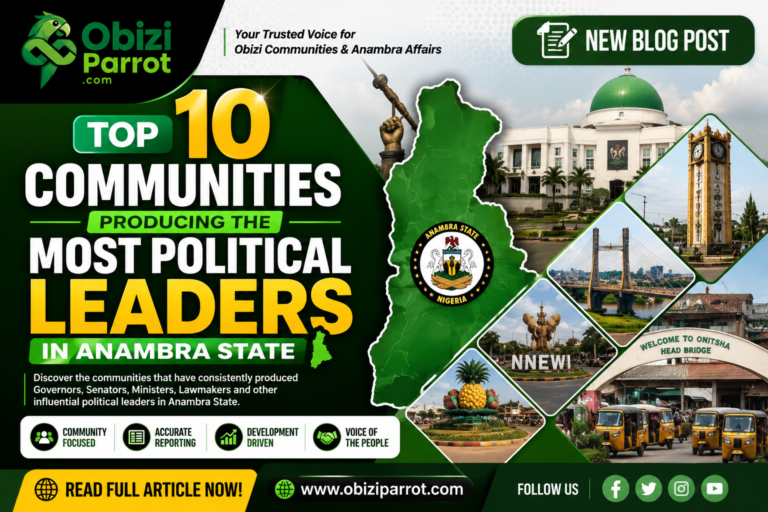
If you look closely at Nigerian politics, Anambra State doesn’t just play the game, it often writes the rulebook. People look at the state and see billionaires, massive markets, and clean roads, but the real engine under the hood is power.
But this power doesn’t just drop from the sky evenly across the 179, most richest communities in the state. If you track the history of the men and women who have run this country, held the state by its neck, or rewritten the economy, you’ll realize everything traces back to a few specific town halls.
Forget the standard textbook summaries. Let’s look at the actual top 10 communities where political heavyweights are manufactured in Anambra.
1. Nnewi: The Self-Funded Powerhouse
People call Nnewi the “Japan of Africa” because of factories and spare parts, but their political machinery is just as heavy as their industries. The thing with Nnewi politicians is that they don’t beg for Abuja money; they fund themselves. When you have independent wealth, your political style becomes fearless.
Look at Dim Chukwuemeka Odumegwu-Ojukwu. The Ikemba himself didn’t just lead a nation; he returned to politics and built APGA, turning it into the political identity card of the entire state. Long before him, Dr. Nwafor Orizu was sitting as Senate President and Acting President in the First Republic. Even Dame Virgy Etiaba made history there as Nigeria’s first female governor during the rough political storms of 2006. Down to the late Senator Ifeanyi Ubah, Nnewi’s style has always been independent, loud, and heavily grassroots-backed.
2. Onitsha Ado: The Intellectual Cradle
Onitsha Ado n’Idu is a different breed. Long before the main market became a global trading hub, Onitsha was the capital of intellectual exposure. Their political power came from early education, royal heritage, and elite exposure to the West.
This is the soil that gave us Dr. Nnamdi Azikiwe, the Zik of Africa. You cannot write Nigeria’s independence without him. Then you look at Ukpabi Asika, who stepped up as Administrator of the East Central State during the hardest years right after the civil war. Onitsha’s political strength has always been in the brains and the law. They produced legal giants like Justice Louis Mbanefo and a continuous stream of federal lawmakers who fought battles with the constitution rather than raw cash.
3. Agulu: The Masters of the Long Game
Agulu doesn’t do loud, flashy politics. Their style is calm, deeply calculated, and heavily focused on the economy. They are the ones who introduced strict corporate accounting into public governance.
The obvious face here is Peter Gregory Obi. His two terms as governor completely ruined the business model of traditional political godfathers in the state. He cleared state debts, saved billions, and used that record to trigger a national political awakening that nobody saw coming. But beyond Obi, Agulu has always had people like Chief Ben Obi (Ojeligbo) moving pieces behind the scenes in national security and federal strategy. They excel at the long, quiet game of power.
4. Isuofia: The Technocrat Headquarters
If you go towards the Old Aguata Union (OAU) axis, Isuofia stands out for one thing: academic pride. Their political philosophy is simple—bring the highest level of economic intellect into government house.
They gave Nigeria Professor Charles Chukwuma Soludo, the current governor. Before he ever looked at the state house, he was the Central Bank Governor who forced the chaotic Nigerian banking sector to consolidate, changing the country’s economy forever. Isuofia politicians don’t talk about stomach infrastructure; they talk about macroeconomics, structural blueprints, and long-term data. They are the elite administrators of the state.
5. Oko: The Home of Democratic Dignity
Oko is known for its federal polytechnic, but its real footprint in history is the sheer decency and structure it brought to Nigerian democracy.
The crown jewel here is Dr. Alex Ifeanyichukwu Ekwueme, Nigeria’s first executive Vice President. Ekwueme was a man of immense intellect multiple degrees across different fieldsbut his biggest political legacy was forming the G-34. That was the group of courageous leaders who looked military dictators in the eye and demanded democracy. He also came up with the six geopolitical zones structure that Nigeria uses to share power today. Oko’s political legacy is one of structural balance and deep statesmanship.
6. Alor: The Grassroots Structure Builders
Alor is in Idemili South, and if you know anything about Anambra Central politics, you know you don’t play with Idemili. Alor politicians are masters of the grassroots grid. They know how to build a political structure that doesn’t break, even under pressure.
They produced Dr. Chris Nwabueze Ngige. Love him or hate him, his short, turbulent time as governor broke the back of the elite godfather system in the early 2000s. He was the one who started the massive road revolution, proving that Anambra’s state funds could actually be used to build roads instead of paying off political sponsors. That structure kept him relevant for decades, through the Senate up to his time as a two-term Minister of Labour.
7. Aguleri: The Omambala Resurgence
For a long time, the northern riverine part of the state (the Omambala axis) felt left out of the main loop of power. Aguleri was the community that changed that narrative completely, proving that power could shift up north and stay there.
They brought in Chief Willie Maduaburochukwu Obiano, who ran the state for eight years. His administration pulled off massive legacy projects that shifted the state’s infrastructure, like the International Cargo Airport at Umueri and the major flyovers in Awka. Aguleri’s political weight comes from a deep mix of cultural brotherhood and strong town union mobilization. When they decide on a direction, the whole community moves as one block.
8. Ogbunike: The Philosophical Orators
Ogbunike is famous for its caves, but in political history, it’s famous for producing people with incredible oratorical power and sharp legislative minds. They don’t just hold power; they define it.
Think of Dr. Chuba Okadigbo, the Oyi of Oyi. He was an academic giant and perhaps the most charismatic Senate President Nigeria ever had. His command of language, political philosophy, and understanding of legislative chess made him a legend in Abuja. Ogbunike leaders have always followed that mold—highly educated, very independent, and sharp-tongued. They are the ones who dominate party debates and write legislative bills.
9. Mbaukwu: Silent Bridge Builders And The Strategic Anchors.
Mbaukwu has mastered a much more sophisticated game just down the road. They don’t waste energy fighting for frontline spotlight; instead, the indigenous people of Mbaukwu have positioned themselves as the silent anchors of state governance, embedding their elite deep into the institutional and spiritual fabric of the state.
They are the ultimate stabilizers, epitomized by the current Deputy Governor, Dr. Onyekachukwu Ibezim (Ife Mbaukwu). Mbaukwu’s strategy relies on producing highly skilled professionals, medical experts, veteran administrators, and highly placed religious leaders who become completely indispensable to whoever is sitting in the Governor’s lodge. They function as the silent, reliable weight that steadies the ship of state, quietly keeping the gears of regional administration turning smoothly no matter how turbulent the political weather gets.
10. Uga: The Old Guard of Public Service
Uga is another heavy hitter from the Aguata line. Their political strength comes from an old-money, old-structure tradition. They have a massive concentration of retired military top brass, federal permanent secretaries, and legal titans.
They gave the state the late Chief Chukwuemeka Ezeife (Owadigo), the Harvard-trained economist who governed during the short-lived Third Republic. Ezeife was a towering intellectual voice who championed equity and restructuring for the Igbo nation until his last days. Uga’s political influence is institutional—whenever federal boards, national constitutional conferences, or high-level judicial appointments are being sorted out, Uga always has a deeply connected son or daughter ready to step in.
Why Does This Keep Happening in These Specific Places?
If you step back and look at the pattern, it isn’t luck. It comes down to two unique things about Anambra’s culture:
- The Power of the “PG” (President-General): In Anambra, town unions are like mini-republics. Before any politician runs for the House of Assembly or Senate, they usually have to test their mic in the village town hall. Managing an Anambra town union is harder than managing some local governments. If you can survive village politics here, Abuja politics becomes a breeze.
- The Mentor Pipeline: It’s a chain reaction. Zik inspired the intellectuals. Ekwueme built a platform that raised younger lawyers. Ngige showed that grassroots structures work. Peter Obi altered the template of accountability, inspiring a whole new crop of youth leaders. Each generation leaves a map for the next one.
If you want to see how the wealth and commercial energy of these exact towns drive the state’s political influence, you can take a look at this documentary on Anambra State’s bustling economic hubs. It shows how the financial independence of these communities directly funds their massive political weight.
The Final Verdict
When you look at the whole picture, you realize that political power in Anambra is never an accident. It is a calculated mix of early exposure, self-funded financial independence, and that stubborn town union culture where people learn how to argue, negotiate, and lead before they ever enter a government office. Whether you are looking at the raw, independent cash power of Nnewi, the heavy intellectual history of Onitsha, the calculating economic long game of Agulu, or the quiet, institutional anchoring of Mbaukwu, every single one of these towns has a distinct strategy for capturing and holding onto power.
But then again, politics is a moving target. The alignments that held the state together ten years ago are not the same alignments running the show today. New economic blocks are rising, young technocrats are displacing the old guard, and the next generation of kingmakers is currently sitting in a village hall somewhere preparing for the next election cycle.
Let’s Talk: Which Town Did We Rob?
Look, no list covering Anambra politics can ever please everybody, and we know some of you are already looking at this thinking your local government area was completely cheated.
So let’s open the floor. Which community absolutely deserved to be on this top 10 list but got left out? Is there a town in your zone that is quietly producing all the heavy-hitting commissioners, federal lawmakers, and strategic masterminds right now while everyone else is sleeping?
Do you think the old-school giants like Nnewi and Onitsha will keep controlling the remote control of the state, or are the technocratic hubs taking over for good?
Hit the comment section and give us the raw facts. Tell us which community we missed and exactly why their political weight means they deserve to be added to the lineup!